
-
TRANSDUCERS
- TRANSDUCERS
-
BASIC COMPONENTS DK
- BASIC COMPONENTS DK
-
MARKETPLACE
- MARKETPLACE
-
DEVELOPMENT BOARDS & KITS
- DEVELOPMENT BOARDS & KITS
-
CABLE ASSEMBLIES
- CABLE ASSEMBLIES
-
RF AND WIRELESS
- RF AND WIRELESS
-
BOXES ENCLOSURES RACKS
- BOXES ENCLOSURES RACKS
-
AUDIO PRODUCTS
- AUDIO PRODUCTS
-
ARTILA
- ARTILA
-
FANS-BLOWERS-THERMAL MANAGEMENT
- FANS-BLOWERS-THERMAL MANAGEMENT
-
WIRELESS MODULES
- WIRELESS MODULES
-
TERMINALS
- TERMINALS
-
Cables/Wires
- Cables/Wires
-
SINGLE BOARD COMPUTER
- SINGLE BOARD COMPUTER
-
BREAKOUT BOARDS
- BREAKOUT BOARDS
-
LED
- LED
-
TEST AND MEASUREMENT
- TEST AND MEASUREMENT
-
POTENTIONMETERS AND VARIABLE RESISTORS
- POTENTIONMETERS AND VARIABLE RESISTORS
-
DEVELOPMENT BOARDS AND IC's
- DEVELOPMENT BOARDS AND IC's
-
EMBEDDED COMPUTERS
- EMBEDDED COMPUTERS
-
OPTOELECTRONICS
- OPTOELECTRONICS
-
INDUSTRAL AUTOMATION AND CONTROL
- INDUSTRAL AUTOMATION AND CONTROL
-
COMPUTER EQUIPMENT
- COMPUTER EQUIPMENT
-
CONNECTORS & INTERCONNECTS
- CONNECTORS & INTERCONNECTS
-
MAKER/DIY EDUCATIONAL
- MAKER/DIY EDUCATIONAL
-
TOOLS
- TOOLS
-
MOTORS/ACTUATORS/SOLEENOIDS/DRIVERS
- MOTORS/ACTUATORS/SOLEENOIDS/DRIVERS
-
FPGA HARDWARE
- FPGA HARDWARE
-
POWER SUPPLIES
- POWER SUPPLIES
-
ROBOTICS & AUTOMATION
- ROBOTICS & AUTOMATION

Specification
| Type | Rotary encoder |
| Applications | Wheel controllers that spin infinitely are useful for controlling audio/video equipment and similar appliances |
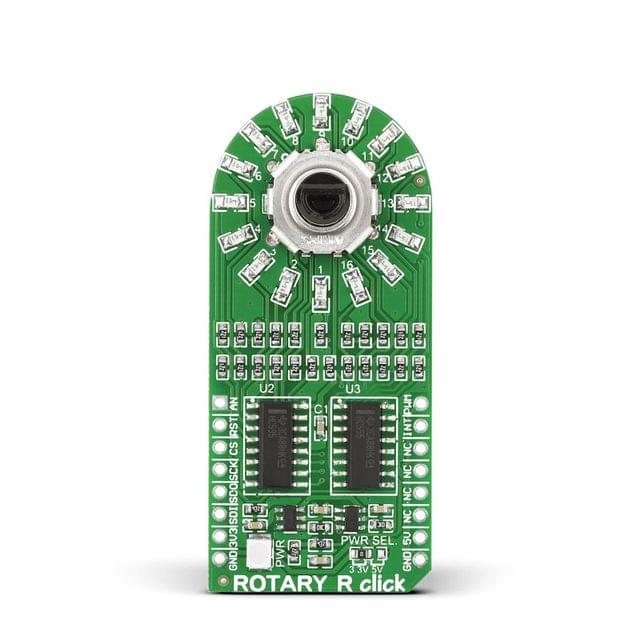
| On-board modules | 15-pulse incremental rotary encoder with detents, surrounded by a ring of 16 red LEDs |
| Key Features | 30 indents (dividing the rotation into discrete increments) |
| Key Benefits | LED ring for visual feedback |
| Interface | SPI,PWM,Analog,GPIO |
| Input Voltage | 3.3V or 5V |
| Compatibility | mikroBUS |
| Click board size | L (57.15 x 25.4 mm) |
Documentation
Features and usage notes
Rotary click with its LED ring is a perfect solution for implementing an input knob into your design (in contrast to a potentiometer, a rotary encoder can be spun round continuously). A single rotation is divided into 15 discrete steps. The encoder outputs A and B signals (out of phase to each other). The knob is also a push-button outputted through the interrupt line. The LED ring are controlled through the SPI interface.
In addition to the SPI lines (CS, SCK, MISO, MOSI), Rotary clicks have three additional lines for outputting the Encoder info: ENCB OUT, ENCA OUT and SW (in place of the standard AN, RST and INT pins, respectively).
All Rotary click boards can be used with either a 3.3V or 5V power supply. The configuration is set up with an onboard jumper (zero ohm resistor). By default, it’s set to 3.3V
- Home
- ROTARY R click
ROTARY R click
SIZE GUIDE
Your enquiry has been sent
Product Enquiry Form
Leave us a message for futher information.
- Shipping in 10-12 Working days
- http://cdn.storehippo.com/s/59c9e4669bd3e7c70c5f5e6c/ms.products/5a57596d616454680145a7a7/images/5a57596d616454680145a7a8/5a57553ef5da4469285d2e07/5a57553ef5da4469285d2e07.jpg
Description of product
Specification
| Type | Rotary encoder |
| Applications | Wheel controllers that spin infinitely are useful for controlling audio/video equipment and similar appliances |
| On-board modules | 15-pulse incremental rotary encoder with detents, surrounded by a ring of 16 red LEDs |
| Key Features | 30 indents (dividing the rotation into discrete increments) |
| Key Benefits | LED ring for visual feedback |
| Interface | SPI,PWM,Analog,GPIO |
| Input Voltage | 3.3V or 5V |
| Compatibility | mikroBUS |
| Click board size | L (57.15 x 25.4 mm) |
Documentation
Features and usage notes
Rotary click with its LED ring is a perfect solution for implementing an input knob into your design (in contrast to a potentiometer, a rotary encoder can be spun round continuously). A single rotation is divided into 15 discrete steps. The encoder outputs A and B signals (out of phase to each other). The knob is also a push-button outputted through the interrupt line. The LED ring are controlled through the SPI interface.
In addition to the SPI lines (CS, SCK, MISO, MOSI), Rotary clicks have three additional lines for outputting the Encoder info: ENCB OUT, ENCA OUT and SW (in place of the standard AN, RST and INT pins, respectively).
All Rotary click boards can be used with either a 3.3V or 5V power supply. The configuration is set up with an onboard jumper (zero ohm resistor). By default, it’s set to 3.3V
Can't find what you're looking for?
From a part number or BOM to an engineering challenge, partnership, academic requirement or career enquiry — start with one conversation.