
-
TRANSDUCERS
- TRANSDUCERS
-
BASIC COMPONENTS DK
- BASIC COMPONENTS DK
-
MARKETPLACE
- MARKETPLACE
-
DEVELOPMENT BOARDS & KITS
- DEVELOPMENT BOARDS & KITS
-
CABLE ASSEMBLIES
- CABLE ASSEMBLIES
-
RF AND WIRELESS
- RF AND WIRELESS
-
BOXES ENCLOSURES RACKS
- BOXES ENCLOSURES RACKS
-
AUDIO PRODUCTS
- AUDIO PRODUCTS
-
ARTILA
- ARTILA
-
FANS-BLOWERS-THERMAL MANAGEMENT
- FANS-BLOWERS-THERMAL MANAGEMENT
-
WIRELESS MODULES
- WIRELESS MODULES
-
TERMINALS
- TERMINALS
-
Cables/Wires
- Cables/Wires
-
SINGLE BOARD COMPUTER
- SINGLE BOARD COMPUTER
-
BREAKOUT BOARDS
- BREAKOUT BOARDS
-
LED
- LED
-
TEST AND MEASUREMENT
- TEST AND MEASUREMENT
-
POTENTIONMETERS AND VARIABLE RESISTORS
- POTENTIONMETERS AND VARIABLE RESISTORS
-
DEVELOPMENT BOARDS AND IC's
- DEVELOPMENT BOARDS AND IC's
-
EMBEDDED COMPUTERS
- EMBEDDED COMPUTERS
-
OPTOELECTRONICS
- OPTOELECTRONICS
-
INDUSTRAL AUTOMATION AND CONTROL
- INDUSTRAL AUTOMATION AND CONTROL
-
COMPUTER EQUIPMENT
- COMPUTER EQUIPMENT
-
CONNECTORS & INTERCONNECTS
- CONNECTORS & INTERCONNECTS
-
MAKER/DIY EDUCATIONAL
- MAKER/DIY EDUCATIONAL
-
TOOLS
- TOOLS
-
MOTORS/ACTUATORS/SOLEENOIDS/DRIVERS
- MOTORS/ACTUATORS/SOLEENOIDS/DRIVERS
-
FPGA HARDWARE
- FPGA HARDWARE
-
POWER SUPPLIES
- POWER SUPPLIES
-
ROBOTICS & AUTOMATION
- ROBOTICS & AUTOMATION

This is an ECG (or EKG) machine on a click board. It measures the electrical activity of a beating heart through electrodes taped to the skin. The board requires little setup, and the final measurement results can be displayed as an Electrocardiogram using a free Windows app.With the ECG click bundle (click + cable + electrodes) you will be able to prototype your own health-tracking and fitness devices, quantified-self wearables… or you can just make an LED blink in sync with your heart.
Setup guide: from heart to skin, from skin to 3.5 mm jack
To start recording ECG you will need:
- 1. ECG click
- 2. Cable
- 3. Disposable adhesive electrode pads (sold in packs of 30)
Of course, you will also need a target board with an MCU with at least a 10-bit ADC (preferably powered from an external battery).
The three electrodes are connected to your left shoulder, right shoulder, and to the left side of the abdomen (below the heart). The last one can also alternatively be fitted on the left leg.
The electrodes are connected to the board with a cable that plugs into the onboard 3.5mm phone jack.
Applications
- Make a portable battery-powered holter with ECG click, microSD click and clicker 2
- Quantified-self data logging: subtle variations in your heart-rate occur from second to second. With ECG click you are not limited to the doctor’s office. Record ECG while you watch TV, read email, talk over the phone – study patterns to see what excites you (HRV - heart rate variability is a good indicator of state of mind).
- Pair ECG click with a wireless transceiver to transmit a heartbeat signal to various electronics (set a LED strip to pulsate in sync with your heartbeat, or the vibro motor on another person's Hexiwear).
Features
- 7-block design (protection, preamplifier, high-pass filter #1, amplifier, high-pass filter #2, low-pass filter, DRL circuit
- Ready-to-use example and free software tool to generate ECG plot
- Jumpers for setting output voltage range
- Trimmer potentiometer to adjust gain
- MCP609 OpAmp
- MAX6106 Voltage Reference IC
- ESD, OverVoltage and OverCurrent protection
- Analog output (mikroBUS™ AN pin)
- 5V power supply
| Type | Biomedical |
| Applications | Measures the electrical activity of a beating heart through electrodes taped to the skin |
| On-board modules | MCP609 OpAmp, MAX6106 Voltage Reference IC |
| Key Features | 7-block design (protection, preamplifier, high-pass filter #1, amplifier, high-pass filter #2, low-pass filter, DRL circuit |
| Key Benefits | ESD, OverVoltage and OverCurrent protection, Analog output (mikroBUS AN pin) |
| Interface | Analog |
| Input Voltage | 5V |
| Compatibility | mikroBUS |
| Click board size | L (57.15 x 25.4 mm) |
- Home
- ECG click
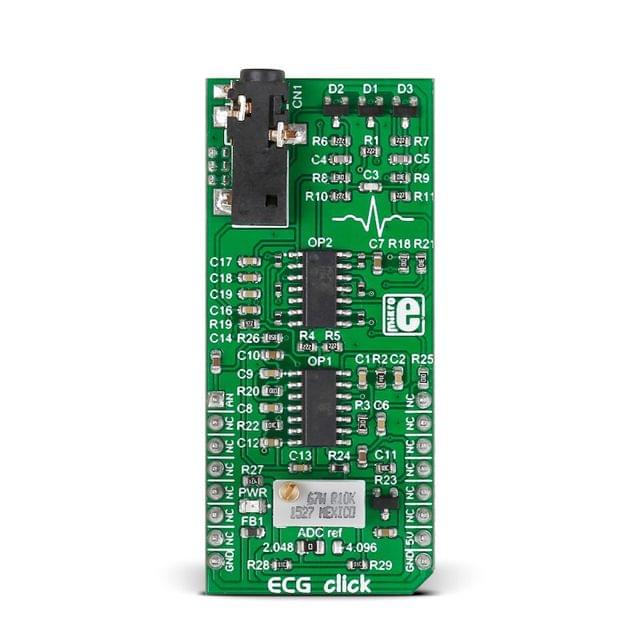
ECG click
SIZE GUIDE
Your enquiry has been sent
Product Enquiry Form
Leave us a message for futher information.
- Shipping in 10-12 Working days
- http://cdn.storehippo.com/s/59c9e4669bd3e7c70c5f5e6c/ms.products/5a9d5185d5a8f4b69172afc8/images/5a9d5185d5a8f4b69172afc9/5a9d4f56a06cf3b63b6d2806/5a9d4f56a06cf3b63b6d2806.jpg
Description of product
This is an ECG (or EKG) machine on a click board. It measures the electrical activity of a beating heart through electrodes taped to the skin. The board requires little setup, and the final measurement results can be displayed as an Electrocardiogram using a free Windows app.With the ECG click bundle (click + cable + electrodes) you will be able to prototype your own health-tracking and fitness devices, quantified-self wearables… or you can just make an LED blink in sync with your heart.
Setup guide: from heart to skin, from skin to 3.5 mm jack
To start recording ECG you will need:
- 1. ECG click
- 2. Cable
- 3. Disposable adhesive electrode pads (sold in packs of 30)
Of course, you will also need a target board with an MCU with at least a 10-bit ADC (preferably powered from an external battery).
The three electrodes are connected to your left shoulder, right shoulder, and to the left side of the abdomen (below the heart). The last one can also alternatively be fitted on the left leg.
The electrodes are connected to the board with a cable that plugs into the onboard 3.5mm phone jack.
Applications
- Make a portable battery-powered holter with ECG click, microSD click and clicker 2
- Quantified-self data logging: subtle variations in your heart-rate occur from second to second. With ECG click you are not limited to the doctor’s office. Record ECG while you watch TV, read email, talk over the phone – study patterns to see what excites you (HRV - heart rate variability is a good indicator of state of mind).
- Pair ECG click with a wireless transceiver to transmit a heartbeat signal to various electronics (set a LED strip to pulsate in sync with your heartbeat, or the vibro motor on another person's Hexiwear).
Features
- 7-block design (protection, preamplifier, high-pass filter #1, amplifier, high-pass filter #2, low-pass filter, DRL circuit
- Ready-to-use example and free software tool to generate ECG plot
- Jumpers for setting output voltage range
- Trimmer potentiometer to adjust gain
- MCP609 OpAmp
- MAX6106 Voltage Reference IC
- ESD, OverVoltage and OverCurrent protection
- Analog output (mikroBUS™ AN pin)
- 5V power supply
| Type | Biomedical |
| Applications | Measures the electrical activity of a beating heart through electrodes taped to the skin |
| On-board modules | MCP609 OpAmp, MAX6106 Voltage Reference IC |
| Key Features | 7-block design (protection, preamplifier, high-pass filter #1, amplifier, high-pass filter #2, low-pass filter, DRL circuit |
| Key Benefits | ESD, OverVoltage and OverCurrent protection, Analog output (mikroBUS AN pin) |
| Interface | Analog |
| Input Voltage | 5V |
| Compatibility | mikroBUS |
| Click board size | L (57.15 x 25.4 mm) |
Can't find what you're looking for?
From a part number or BOM to an engineering challenge, partnership, academic requirement or career enquiry — start with one conversation.